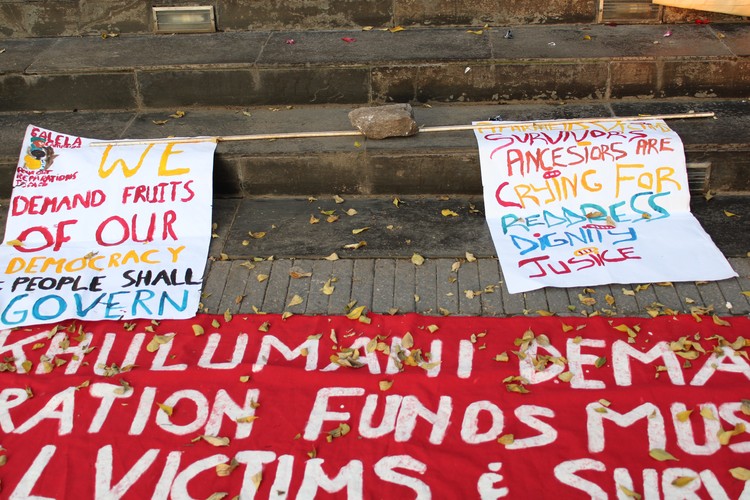
South Africa must revisit its approach to reparations, including by expanding access beyond the narrow confines of the TRC victim list, simplifying administrative processes, and investing in community-based programmes that address systemic inequality, writes Cathy-Ann Potgieter.
CSVR | CENTRE FOR THE STUDY OF VIOLENCE AND RECONCILIATION
Browsing
The Tunisian Truth and Dignity Commission (Instance Vérité et Dignité) (2013-2019) was mandated to investigate human rights violations committed from 1955 to 2013. The mandate specifically tasked the commission with investigating human rights violations that targeted women, children, the elderly, those with special needs and other vulnerable groups.
After years of British colonialism and later white minority rule, the liberation movements in Rhodesia achieved black majority rule with the signing of the Lancaster House Settlement in 1979. In March 1980, the country held its first democratic elections, resulting in Robert Mugabe, of the Zimbabwe African National Union-Patriotic Front (ZANU-PF) political party, becoming the...
The four-person Commission of Inquiry into the Matabeleland Disturbances, known as the Chihambakwe Commission after its chairperson, was mandated to investigate the killings of 1,500 political dissidents and other civilians in the Matabeleland region in 1983 and to gather testimony. The National Peace and Reconciliation Commission (2018-present) was mandated to foster post-conflict justice, healing and...