
South Africa must revisit its approach to reparations, including by expanding access beyond the narrow confines of the TRC victim list, simplifying administrative processes, and investing in community-based programmes that address systemic inequality, writes Cathy-Ann Potgieter.
More than three decades after the end of apartheid, victims and survivors of the regime are still sleeping outside the Constitutional Court, waiting for justice that was promised but never delivered. Some have tragically passed away while waiting, proving that this is not just an administrative failure, but a profound moral and legal one.
South Africa’s commitment to reparations, a cornerstone of its democratic transition, remains largely unfulfilled. Human Rights Day, commemorating the Sharpeville Massacre of 21 March 1960 in which 69 people were killed protesting pass laws, is meant to remind us both of the brutality of apartheid and the responsibility to address its legacy. It reminds South Africans not only of the struggle for rights but also of our continuing responsibility to address historical justice. Over thirty years into South Africa’s democracy, the question of reparations remains unfinished.
The Truth and Reconciliation Commission (TRC) of South Africa, established in 1995, was central to South Africa’s transitional justice project. Its mandate was not only to uncover the truth about gross human rights violations committed between March 1960 and May 1994, but also to restore the dignity of victims and recommend measures to prevent future abuses. Crucially, this included recommendations on reparations and the establishment of a closed list of victims from the hearings.
Reparations were never intended as charity, but as a moral and legal obligation of the democratic state as an essential counterpart to truth-telling and conditional amnesty. The TRC recommended a comprehensive reparations programme, including financial compensation, access to education, housing support, healthcare services, assistance with exhumations and reburials, and the rehabilitation of affected communities.
Instead, the state adopted a far narrower approach. In 2003, the government established a President’s Fund and provided once-off individual payments of ZAR 30,000 to the closed list of victims who registered with the TRC. Of approximately 17,000 recognised victims, nearly all but thirteen received this payment. Some additional support for education was later introduced, including funding of up to ZAR 60,000 per year for higher education.
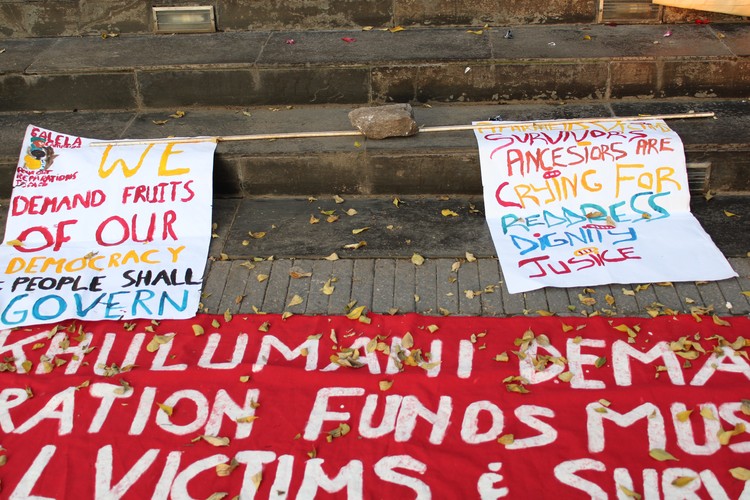
But these measures fell far short of the TRC’s vision. Today, just over ZAR 2 billion remains unspent in the Fund, while many victims continue to live in poverty without adequate support. The Khulumani Galela Campaign, which has seen victims protesting outside the Constitutional Court since 2022, underscores the depth of frustration and desperation.
Civil society organisations, including the South African Coalition for Transitional Justice, have consistently called for a more inclusive and effective reparations programme. One of the central issues is the fact that the TRC’s list of beneficiaries is ‘closed’. Evidence suggests that some victims were excluded due to capacity constraints or procedural barriers during the TRC process. Yet the Department of Justice has largely maintained a restrictive approach, limiting access to reparations and offering little transparency in how claims are processed.
Even for those recognised, access to benefits remains uneven and inadequate. Educational support has reached only a fraction of eligible beneficiaries – approximately 3,000 for basic education and 630 for tertiary education – despite the estimated 17,000 victims and multiple dependents per household. The application processes are often complex and inaccessible, with many requiring assistance to complete.
Other aspects of reparations have been similarly delayed or underdeveloped. Housing support, recommended by the TRC, has made little progress, with draft guidelines emerging only in 2022. Healthcare provision remains unclear, with responsibility shifting between departments with little public accountability. Community rehabilitation initiatives have been limited to a small number of sites, with insufficient transparency about how these communities were selected.
These gaps point to a broader problem: the dilution of South Africa’s reparative justice project. By reducing reparations to limited, individualised payments, the state has failed to address the structural and collective harms of apartheid. This is particularly concerning in a country where inequality remains deeply rooted in historical dispossession, and where the effects of apartheid continue to shape access to land, education, healthcare, and economic opportunity.
Reparations, in their fullest sense, are about more than compensation – they are about recognition, dignity, and healing, signalling that the state acknowledges the past harm and is committed to redressing it in meaningful ways. Without this, the legitimacy of the broader transitional justice process is weakened.
South Africa must urgently revisit its approach to reparations. This includes expanding access beyond the narrow confines of the TRC list, simplifying administrative processes, and investing in community-based programmes that address systemic inequality. Equally important is the need for transparency and accountability in the management of the President’s Fund. At a time when billions remain unspent, continued delays are indefensible.
The unfinished business of reparations is not just about the past. It is about the kind of society South Africa aspires to be. A democracy built on dignity, equality, and justice cannot afford to leave its most vulnerable behind. Until the promise of reparations is realised, South Africa’s transition remains incomplete. Until the state moves from symbolic acknowledgement to substantive redress, the promise of justice will remain hollow, and South Africa’s democracy will stand not as a testament to transformation, but as a reminder of a debt it has yet to pay.

Cathy-Ann Potgieter
Cathy-Ann Potgieter is a Legal Officer with the Centre for the Study of Violence and Reconciliation.